

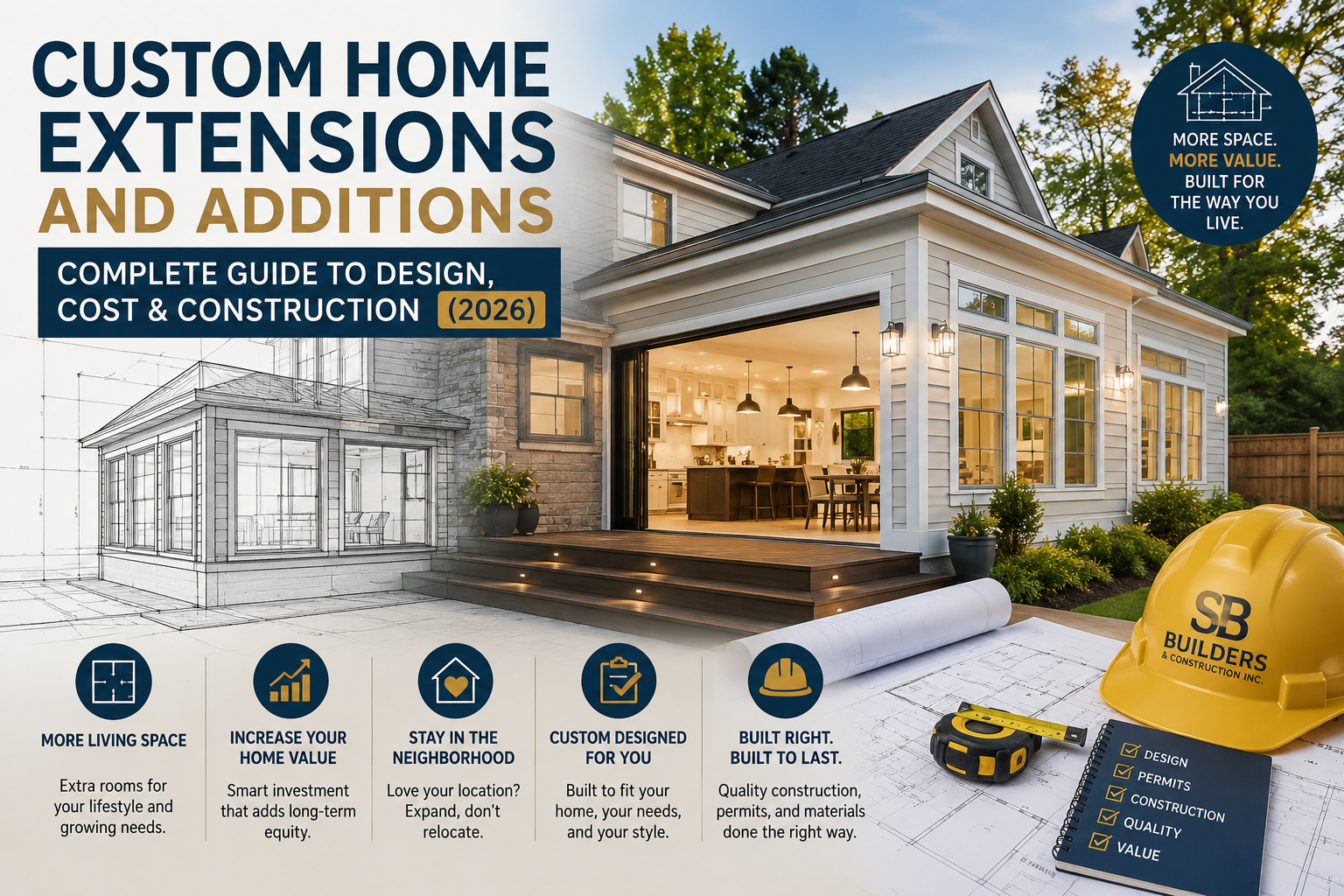
What Are Custom Home Extensions and Additions?
A custom home extension is a permanent structural addition built onto an existing house to increase its total living space. This type of residential construction physically expands the size of your property, either outward across the lot or upward through a second story. The result is new square footage that serves a specific purpose, whether that is an extra bedroom, a larger kitchen, a home office, a garage, or a fully equipped in-law suite.
Home additions are different from interior remodeling projects. When you remodel a kitchen or bathroom, you are working within the boundaries of space that already exists. When you build a home addition, you are creating entirely new space that was never there before. That distinction matters because additions require foundation work, structural framing, roofing integration, and connection to your existing mechanical systems, including heating, cooling, plumbing, and electrical.
In the Northern Virginia housing market, custom home additions have become one of the most practical solutions for homeowners who need more space but are not ready to sell and buy a larger property. The combination of high home prices, limited inventory in desirable school districts, and the significant cost of relocation has pushed many Fairfax County, Arlington, and Alexandria homeowners toward expanding the house they already own rather than starting over somewhere else.
The key to a successful home extension is treating it like the major construction project it is. This means working with a licensed general contractor who has direct experience in residential additions, securing all required building permits before work begins, and using quality materials that integrate naturally with the existing structure. When those conditions are met, a home extension adds lasting value, improves daily life, and strengthens the long-term financial position of the homeowner.
Why Homeowners in Northern Virginia Choose Extensions Over Relocating
Financially, the logic behind adding an addition to your home rather than selling and purchasing a new home makes a great deal of sense in the Northern Virginia area. First, when selling a home and buying a new home, one takes commissions and closing costs on each transaction, along with moving costs, and the vast majority of the time, a mortgage that is much more expensive than adding an addition to your existing home with equity in the property.
Beyond this, there are things that cannot be quantified by money, but which can have huge personal and emotional implications for individuals and families. Many people in the Northern Virginia area choose to remain in their communities based on school districts, closeness to employment, friendships, and other community ties that have been built up over many years. Adding an addition simply allows the home to fit into the life they have created for themselves within the community.
The demands behind such extensions are logical and easy to comprehend. A couple adds another member and now does not have any more rooms left. A busy professional wants to have an office at his own place of residence and does not want to sacrifice his guest bedroom for the purpose. The time comes to care for one's parents who need to live in accessible housing. People get the dream house where all looks great except of its kitchen which happens to be very small. In any case, there is a need for additional space. And constructing this space is always cheaper than acquiring an already existing piece of land somewhere else.
Moreover, home additions make it possible for owners to control quality and design themselves, which is impossible to do when purchasing ready-made property. When building a custom home extension, all decisions about materials, finishes and other details are yours.
Types of Home Additions and Extensions
Understanding the range of available addition types helps homeowners match the right solution to their specific situation. The type of addition that makes the most sense depends on lot size, zoning rules, the configuration of the existing home, budget, and the purpose the new space needs to serve.
- Room additions are the most common category of residential extensions. A room addition expands the main floor of the house by adding one or more rooms along the side or rear of the structure. These additions can serve as bedrooms, home offices, sitting rooms, playrooms, or hobby spaces. Room additions are generally the most straightforward type of extension from a structural and permitting standpoint.
- Second story additions are the right solution when a homeowner wants to significantly increase square footage but the lot does not allow outward expansion. Building vertically can effectively double the living area of a single-story home. Second story additions require careful structural engineering to confirm that the existing foundation and walls can support the additional load. They represent a larger upfront investment but can dramatically transform both the livability and market value of a property.
- Garage additions remain in consistently strong demand across Northern Virginia. Whether the project involves adding a new attached garage, expanding an existing one, or constructing a detached structure, a garage addition increases practical utility and adds meaningful value at resale. Many homeowners pair a garage addition with a mudroom connection, a laundry room, or a bonus room above the garage to extract maximum value from the project.
- Breezeway additions create a covered and often fully enclosed passageway connecting the main house to a detached garage, guest suite, or outdoor structure. A well-designed breezeway adds architectural character to the property and provides a functional, weatherproof transition between structures. It is a project that improves both the appearance and the practicality of a home simultaneously.
- Kitchen extensions address one of the most common complaints homeowners have about their existing properties. Bumping out the kitchen wall by ten to fifteen feet creates room for a larger island, additional cabinetry, a dedicated dining area, or better circulation through the space. Even a modest kitchen extension can fundamentally change how a home feels and functions on a daily basis.
- In-law suite additions have grown significantly in demand as multi-generational living becomes more common in Northern Virginia households. A complete in-law suite includes a bedroom, a full bathroom, and a small kitchen or kitchenette, creating a self-contained living space within or attached to the main home. Depending on local zoning rules, some in-law suites may also qualify for accessory dwelling unit status, which can create rental income potential.
- Sunroom and screened porch additions bring usable outdoor-oriented living space into the home in a way that works with Northern Virginia's climate. Glass-intensive sunroom additions work well in spring and fall when outdoor temperatures are pleasant but direct exposure to the elements is not ideal. Screened porch additions extend the entertaining season through the warmer months without the full cost of a climate-controlled room addition.
- Mudroom additions are one of the most practical improvements available to Northern Virginia homeowners. A dedicated mudroom with built-in storage, a bench, hooks, and easy-to-clean flooring creates an organized transition zone between the garage or backyard and the main living areas. It keeps clutter out of the kitchen and hallways and protects interior floors from weather and seasonal wear.
- SB Builders and Construction specializes in all of these additional types. Every project begins with a thorough assessment of the existing home, the homeowner's goals, and the site conditions that will shape what is possible. You can learn more about specific services on the New Home Additions page of our website.
Home Addition Cost: What to Budget in Northern Virginia
Home addition costs in Northern Virginia are influenced by several overlapping factors: the type and size of the addition, the complexity of the structural and mechanical work involved, the quality of materials selected, permit fees, and current conditions in the regional construction labor market. Northern Virginia sits in one of the higher-cost construction markets on the East Coast, which means project budgets should be built with that context in mind rather than based on national averages that do not reflect local conditions.
For a single room addition in Fairfax or Arlington, most homeowners should budget between $50,000 and $120,000 depending on the size of the room and the finish level selected. A master suite addition with a private bathroom and walk-in closet typically falls in the range of $100,000 to $200,000. Second story additions, which represent the most structurally complex category of residential extension, generally cost between $150,000 and $350,000 for a full upper floor addition. Attached garage additions typically run from $45,000 to $110,000. Kitchen bump-outs range from $40,000 to $100,000, and in-law suite additions generally fall between $90,000 and $180,000 for a fully equipped space.
These ranges are reference points, not fixed quotes. The only way to know what a specific project will cost is to have a licensed contractor evaluate the existing home, review detailed plans, and prepare a line-item estimate based on the actual scope of work. SB Builders provides free detailed estimates for all residential addition projects, and we encourage every homeowner to request a thorough written quote before making any commitment.
Several factors consistently drive costs above the baseline range. Load-bearing wall modifications required for second story additions or open-plan kitchen extensions involve structural engineering work that adds meaningful cost. High-end exterior cladding materials such as brick or natural stone cost more than fiber cement or vinyl siding but deliver greater permanence and visual character. Adding new HVAC zones to properly condition the addition requires equipment and ductwork investment. And foundation work in areas with challenging soil conditions or high seasonal water tables involves additional preparation.
SB Builders also offers flexible financing for home additions for projects of any size regardless of credit score, which allows homeowners to move forward on their addition without waiting to accumulate the full construction budget.
Design and Architectural Planning for Home Extensions
This step is the one that will make or break your home extension. A good design resolves the problem it was intended to solve, fits in well with the rest of your house, and works efficiently for years to come. A poor design creates inefficient spaces, looks out of place on your property, and may even require you to redo part of your work at great expense.
Architectural continuity is the key component of an excellent addition design. It must appear as though the building was always there, rather than just added later to an existing building. In order to achieve architectural continuity, one would need to match the roof slope and roof materials to the existing structure, choose either the same siding material used by the existing building or another that complements the first, have the windows proportionally match those in the old structure, as well as match the trim styles and architectural elements. However, interior architectural continuity cannot be overlooked in the process of designing an addition. There needs to be cohesion within the floor plan of the addition, and the addition itself should flow nicely into the existing floor plan. The circulation should feel intuitive, and the rooms should logically fit together for a particular family. One does not want any imbalance of scale between the existing structure and the addition. This will be identified and fixed at the design stage by a competent general contractor/design-build firm, which can afford it.
Efficiency should be considered during the initial design phase. According to Virginia’s building code for residential buildings, there are mandatory standards for the thermal insulation, window systems, and air tightness of new buildings and building extensions. These should be satisfied, while surpassing them makes economic sense. A highly insulated and sealed addition can lessen the energy demand for both the whole house and the new addition.
Construction Materials for Home Extensions
- Material selection in a home addition affects structural performance, long-term durability, energy efficiency, visual continuity with the existing home, and the total cost of ownership over the life of the structure. Understanding the key material decisions helps homeowners make informed choices rather than simply deferring to whatever a contractor recommends without understanding the reasoning.
- Structural framing in residential additions in Northern Virginia is primarily dimensional lumber, supplemented by engineered wood products such as laminated veneer lumber beams for longer spans or specific load conditions. The framing system must be sized and configured to carry the structural loads of the new addition and any forces transferred back into the existing structure. For second story additions, a structural engineer typically reviews and stamps the framing plans before permit submission.
- Foundation type depends on the existing home's foundation configuration, the soil conditions on the specific site, and the intended use of the new space. Poured concrete slab foundations are common for room additions and garage additions. Crawl space foundations with masonry or poured concrete walls are used when soil or drainage conditions favor a raised floor system. Full basement extensions are possible in some situations and significantly expand the utility of the addition. Waterproofing is a critical consideration in all foundation types given Virginia's climate.
- Exterior cladding choices are driven by both aesthetics and performance. Fiber cement siding has become the dominant choice in Northern Virginia residential construction because of its durability, moisture resistance, dimensional stability, and paint retention. Brick and stone veneer provide greater permanence and visual weight for homeowners seeking a more traditional or substantial appearance. In HOA-governed neighborhoods, exterior material selection may be subject to architectural committee review requirements that must be satisfied before construction begins.
- Roofing integration between the new addition and the existing structure requires careful attention to flashing at every point where roof planes meet walls or other roof surfaces. These intersections are the most common source of water infiltration in poorly executed additions, and proper flashing installation is non-negotiable regardless of the roofing material used. Matching the existing roofing material maintains visual continuity and prevents the addition from appearing disconnected from the original home.
Permits, Zoning, and Building Regulations in Fairfax County
Every home addition in Virginia requires a building permit. Working without permits exposes homeowners to serious legal and financial consequences. Unpermitted additions complicate or prevent the sale of the home, void homeowner's insurance coverage on the affected structure, and may require costly demolition or reconstruction to achieve compliance before a sale can proceed. There is no legitimate cost-saving rationale for skipping the permit process.
Firstly, there is the zoning confirmation. The addition will have to conform to the setback rules, which set out how close the building is allowed to be to each of the lot's edges, as well as the percentage lot coverage that sets how large a proportion of the whole lot may be built on by the structures. There are height rules as well, but all of them differ depending on the type of the zone, which is why they need to be confirmed prior to developing the project. The next step will be submitting the complete architectural drawings and, when necessary, structural drawings to the Department of Land Development Services of Fairfax County. It takes about four to eight weeks to complete such a plan review. Additional trade permits will be needed for the electrical, plumbing, and HVAC work done during the project.
Inspections are mandatory during construction phases such as the foundation phase, framing phase, rough electrical phase, rough plumbing phase, rough mechanical phase, insulation, and final inspections of the building and trades. It is illegal to move beyond any of these phases of inspections without the permission of the inspector conducting the inspections. A Certificate of Occupancy is then granted after the successful completion of all final inspections.
SB Builders manages the entire permitting and inspection process on behalf of clients. Details about how we structure and manage each project from start to finish are available on our project process page. The official Virginia residential construction code is maintained by the Virginia Department of Housing and Community Development and governs all residential construction work in the state.
The Home Addition Construction Process
A home addition project moves through a series of well-defined phases, each of which depends on the successful completion of the phase before it. Understanding this sequence helps homeowners know what to expect at each stage and reduces the uncertainty that often makes construction projects stressful.
- Pre-construction work covers everything that happens before any physical construction begins. This phase includes finalizing design documents, submitting permit applications, ordering materials with long lead times, coordinating utility locates and markings, and preparing the construction site. This phase also involves identifying any existing conditions in the home that could affect the addition, such as load-bearing walls that require relocation, mechanical systems that need rerouting, or foundation conditions that differ from what was originally assumed.
- Once permits are issued, site preparation and foundation work begin. Excavation is followed by forming, pouring, and curing the concrete foundation components, then waterproofing installation and drainage system construction. Foundation inspection must be passed before framing can begin.
- Structural framing proceeds after the foundation inspection is approved. Walls, floor systems, and roof framing go up in sequence, transforming the project from abstract plans into a visible three-dimensional structure. Framing inspection by the county building inspector is required before the structure is sheathed and roofed.
- Rough mechanical work follows framing inspection. Electrical rough wiring, plumbing drain and supply rough-in, and HVAC ductwork or piping are installed through the open framing. Each of these trades requires its own rough inspection before insulation can be installed. Insulation installation follows the mechanical rough inspections, after which drywall is hung, taped, and finished.
- Finish work is the final construction phase: flooring installation, interior trim carpentry, cabinet installation, countertops, tile work, fixture installation, hardware, and paint. This is the phase that reveals the full quality of the craftsmanship and the accuracy of the design. After all trade final inspections are completed and the Certificate of Occupancy is issued, a formal walkthrough with the homeowner identifies any remaining items to be completed before the project is closed.
Return on Investment and Property Value from Home Additions
Home additions are consistently among the highest-return improvements available to Northern Virginia homeowners, but only when the project is properly executed, fully permitted, and sized appropriately for the neighborhood. An addition that is built correctly and matches the character of the surrounding homes increases the appraised value of the property, improves its competitive position in the resale market, and delivers years of utility to the household before any sale occurs.
The additions that produce the most reliable return on investment in Northern Virginia include primary suite additions in homes that lack a master bathroom, garage additions in suburban neighborhoods where off-street covered parking is expected, and kitchen expansions in homes where the original kitchen is disproportionately small relative to the rest of the house. Second story additions carry a higher construction cost but can move a property into a completely different price category in the local market.
The Remodeling Cost vs. Value Report provides annual data on the relationship between construction costs and resale value recovery for major home improvement projects across U.S. markets. Mid-Atlantic market data consistently shows that well-executed home additions in competitive neighborhoods recover a substantial percentage of construction cost at resale, with the homeowner receiving the full benefit of the additional living space during the years between construction and sale.
One important discipline in addition planning is avoiding over-improvement relative to the price ceiling of your immediate neighborhood. An addition should bring your home up to the standard of the best comparable properties in your area, not dramatically above it. A licensed contractor with local market knowledge and a trusted real estate professional can help you calibrate the scope of your addition to maximize financial return alongside lifestyle improvement.
Common Mistakes to Avoid in Home Addition Projects
Certain mistakes recur consistently across home addition projects and are worth knowing about before you begin planning yours. Awareness of these patterns substantially increases the likelihood that your project will deliver the outcome you are expecting.
- Selecting a contractor based primarily on price is the mistake that causes the most damage. The lowest bid almost always reflects reduced quality somewhere in the project, whether through inferior materials, unlicensed subcontractors, permits that are not properly pulled, or a business that will not be financially viable by the time warranty issues surface. A licensed Class A General Contractor in Virginia with verifiable references, a complete project portfolio, and proper insurance coverage is worth paying a fair market price for.
- Proceeding without permits is a mistake that no reputable contractor will encourage. Any contractor who suggests that permits are optional or that they can be obtained after the fact should be disqualified from consideration. Working without permits creates legal exposure that follows the property, not just the current owner.
- Underbudgeting for the total project cost is a common financial mistake. Construction permit fees in Fairfax County typically run between $1,500 and $5,000 for residential additions. Landscaping disruption from excavation and material staging will require restoration after construction. Unexpected conditions discovered once work begins, such as buried utilities in unusual locations, substandard existing framing that requires repair, or soil conditions that require additional foundation preparation, are normal occurrences in residential construction. A contingency budget of ten to fifteen percent of the total construction cost should be set aside before the project begins.
- Failing to check HOA requirements early in the planning process can force expensive redesigns after permits have already been submitted. Many Northern Virginia neighborhoods governed by homeowners associations require separate architectural review and approval of exterior modifications. This process operates independently of county permitting and must be completed before finalizing design plans.
Frequently Asked Questions
The average time required for adding rooms to homes in Northern Virginia ranges from four to eight months from conception to completion. Adding a whole additional level to your house will require eight to twelve months. Fairfax County’s permit process requires four to eight weeks on average prior to construction commencement, and this information is included in SB Builders’ initial schedule estimation to ensure transparency regarding the entire project timeline.
In almost all cases, not really. The process of room additions is mainly done externally to the house and does not affect the day-to-day activities of the residents until the time comes for tying it in with the house. Room additions at the second floor level cause more interference to the occupants compared to other additions. The sequence of construction done by SB Builders is done in such a manner as to limit household disturbance.
Financing is offered by SB Builders for any home additions of any scale; there will be financing options available no matter what your credit rating may be. Typical methods for financing by homeowners include the home equity line of credit, the cash out refinance, the FHA 203k loan, and personal loans for home improvements. There are unique terms and requirements for each of these financing options.
First, a site evaluation should be done by a contractor with the right licenses, who is able to assess the zoning setback, maximum lot coverage, current conditions of the foundation, and any other factors regarding the site that could be problematic for the development project. For instance, at SB Builders, we undertake site evaluations prior to making a free estimate, so as to ensure that our clients know what is feasible with their own particular sites.
A home addition creates new square footage by expanding the physical structure of the house. A full home renovation updates and improves existing spaces within the current building envelope. Many homeowners pursue both at the same time, adding new space while simultaneously improving existing rooms. SB Builders offers Full Home Renovations and New Home Additions as separate services or as combined project scopes depending on what each client’s home and goals require.
Why Choose SB Builders and Construction for Your Home Extension
SB Builders & Construction, Inc. is a Class A Licensed, Bonded and Insured General Contractor headquartered in Fairfax, VA. For more than two decades now, the firm has offered custom home additions, complete remodeling, new constructions, and specialty residential construction services in Northern Virginia, Maryland and Washington DC. SB Builders is an owner-managed firm whereby the client works directly with the owner of the firm right from start to finish in all phases of his or her projects without having to go through salespeople, project managers, and sub-contractors he or she knows nothing about.
SB Builders uses its own professional builders instead of sub-contracting. This approach ensures that all jobs carried out by the firm are done according to the same high standards and there is accountability throughout any project irrespective of its size and difficulty. The professionals are proactive and have enough experience to identify possible issues before they arise. We serve the areas of Fairfax, Arlington, Alexandria, Montgomery County, Howard County, Anne Arundel County, Prince George's County, and other parts of the greater Northern Virginia and DC area. Our services consist of adding rooms, adding second stories, garages, breezeways, kitchen additions, bathroom additions, home renovations, new homes construction, basements additions and renovation, framing, foundation construction, and any other specific type of construction you may need.
Financing options are flexible, and no matter what your credit score is, we can get you financed on your project of any size. Free estimates are also available for all your home addition projects. For more information and to set up an appointment for your free estimate, contact us by phone at 703-625-0132, via email at Info@sbbuildersandconstructioninc.com, or in person at 3701 Morningside Dr, Fairfax, VA 22031.
There is more potential in your home than you think. We at SB Builders are here to build it.