

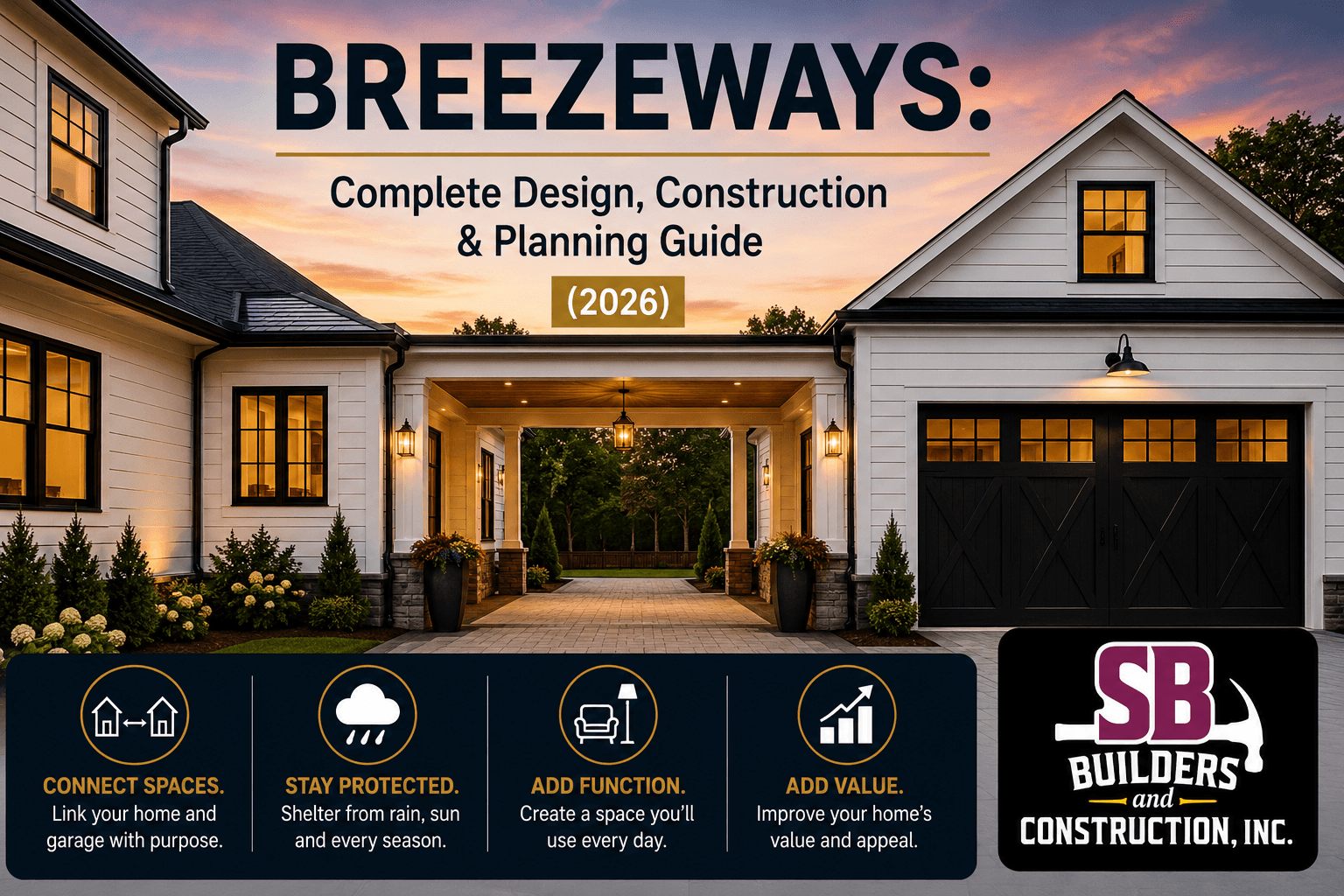
Most homeowners come to us with a straightforward request. They want to stop getting soaked walking from the garage to the back door. That is usually where the conversation starts. By the time we finish talking through options, the vision has grown into something far more useful: a proper breezeway that connects the two buildings, adds functional space, and makes the whole property feel more intentional.
That shift happens because a breezeway is genuinely more versatile than people initially realize. It is not just a roof between two buildings. Done right, it becomes one of the most-used spaces on the property. At SB Builders and Construction Inc., we have built enough of them to know what works, what gets skipped too often, and where projects tend to go sideways. This guide covers all of it.
What Is a Breezeway?
A breezeway is a roofed passage that physically links two separate structures. In most residential projects, that means a house and a detached garage, though it can also connect two wings of the same home or a main residence and a guest structure. The name comes from what these passages were originally designed to do in warmer climates: let the breeze move through while keeping sun and rain off.
That original purpose still holds, but the definition has stretched considerably. Today a breezeway might be a completely open covered walkway, a screened outdoor room, or a fully enclosed space with insulation, heat, and finished walls. Each version solves a different problem and suits a different climate and budget.
What distinguishes a breezeway from a simple porch or a room addition is that it connects two separate buildings and manages the transition between them. It is anchored to both structures, designed to handle weather exposure on all sides, and built as a permanent part of the property. That distinction matters when it comes to permitting, construction standards, and how the space performs long-term.
Benefits of Adding a Breezeway
The most obvious benefit is protection from weather, and it is hard to overstate how much that changes daily life. Carrying groceries through a January storm, getting kids from the car to the house without everyone getting drenched, moving tools and equipment between the garage and the house without a detour around the yard a covered connection between the two buildings solves all of that immediately.
Beyond convenience, a breezeway improves how the property reads visually. A house and a detached garage sitting separately on a lot always look slightly unfinished, like two things that belong together but were never quite introduced. A breezeway completes the composition. It gives the property a cohesive layout and signals that someone thought carefully about how everything connects.
There is also a value argument. According to the National Association of Realtors, functional home improvements that improve accessibility and livability consistently rank among the upgrades buyers notice and appreciate. A well-executed breezeway falls squarely into that category, particularly in markets where buyers are comparing properties with detached garages.
The less obvious benefit is the bonus space that a properly designed breezeway creates. Depending on width and whether it is enclosed, a breezeway can absorb functions that currently have no good home: coats and boots near the door, recycling bins, lawn equipment, a utility sink, a chest freezer. It becomes the space between the house and garage that catches everything that would otherwise end up somewhere inconvenient.
Breezeway vs Covered Walkway
The terms get used interchangeably online, but they describe different things in practice. A covered walkway is typically a freestanding structure, sometimes not attached to either building at all. It provides overhead protection along a path but has no structural relationship with the buildings on either end.
A breezeway is integrated into both structures. It connects to the walls or foundations of each building, shares or coordinates with their rooflines, and is designed and permitted as a permanent addition rather than a freestanding accessory. The attachment changes everything: the structural requirements, the permitting process, the waterproofing demands at the connection points, and how the finished product holds up over time.
If a contractor proposes a solution that simply sets posts in the ground and throws a roof between the house and garage without proper connections to either, that is a covered walkway at best. It may look similar at first but it will not perform the same way, and it will not meet building code in most jurisdictions.
Breezeway vs Mudroom
A mudroom is inside the house. It sits just past the entry door and exists to create a buffer between the outdoors and the main living space. Shoes come off there. Coats get hung there. Wet gear gets dropped there.
A breezeway occupies the space between two buildings. It is not inside either one, though an enclosed breezeway can be brought into the conditioned envelope of the home with enough insulation and HVAC work. The confusion between the two arises because a well-designed breezeway almost always incorporates mudroom-style features: a bench near the door, coat hooks on the wall, durable flooring that tolerates wet boots.
Combining both functions into the breezeway is usually a better solution than building a separate mudroom addition. The space is already there, already transitional by nature, and already getting daily foot traffic. Designing it to absorb the mudroom function adds very little to the construction cost and eliminates the need for a separate interior addition.
Types of Breezeways
The three main types represent a spectrum from simple and minimal to fully enclosed and weather-proof. Which one makes sense depends on the climate, how the space will be used, and what the budget allows.
Open Breezeways
An open breezeway has a roof and structural posts but nothing closing off the sides. It handles direct sun and overhead rain reasonably well but offers limited protection from wind-driven rain, cold, or insects. In genuinely warm, dry climates, this is often all that is needed and the lower cost and simpler construction make it an attractive option.
For most of the country, though, an open breezeway ends up feeling like a compromise. It works four or five months of the year and sits unused the rest. Homeowners who build open breezeways in mixed-climate regions sometimes come back a few years later asking about enclosure options. Planning for that possibility upfront, even if full enclosure is not in the immediate budget, saves money in the long run.
Enclosed Breezeways
A fully enclosed breezeway has walls, windows, insulated construction, and doors at both ends. It functions year-round regardless of weather, and because it is inside the thermal envelope of the home, it can be heated and cooled through an extension of the existing HVAC system or with a dedicated mini-split unit.
This version costs the most to build and requires the most detailed permitting and construction work. It also delivers the most utility. Enclosed breezeways regularly become the most-used entry point of the house. Families run all their daily traffic through them because the combination of weather protection, mudroom function, and direct garage access is simply more practical than any other entry. For four-season climates, this is usually the right answer if the budget supports it.
Covered Breezeways
A covered breezeway sits between open and enclosed. It has a roof and some degree of side treatment screens, partial walls, decorative railings, or some combination but is not fully weatherproofed. Screened versions work well in regions where insects are a significant concern but full enclosure is not necessary for temperature reasons. Partial walls can provide meaningful wind protection without eliminating the outdoor character of the space.
This type is flexible and tends to be the most popular choice in temperate climates. Outfitted with a ceiling fan, good lighting, and a couple of durable chairs, a covered breezeway becomes an outdoor living area that gets genuine daily use through most of the year.
Breezeway Design Ideas
- The single biggest design mistake is treating the breezeway as a separate project from the house. It is not. It attaches to two buildings and will be visible every time someone looks at the property from the street or the yard. The roofline, siding, trim details, and window style should all reference the existing architecture. When the materials match, the breezeway looks like it was always part of the original plan. When they do not, it looks exactly like what it is: something added later without enough thought.
- Natural light is worth investing in. Enclosed breezeways in particular can feel narrow and dark without a deliberate strategy for getting daylight in. Skylights solve this problem cleanly. Clerestory windows work well along the upper wall. Polycarbonate roofing panels are a lower-cost option for covered breezeways where transparency is more important than insulation value.
- Lighting for nighttime use matters more than most people account for during planning. Ceiling-mounted fixtures, sconces at each entry door, and low-level pathway lighting along the floor edges all make the space safe and usable after dark. Motion-sensor switching is a practical addition that most homeowners appreciate.
- Modern breezeways increasingly reflect the direction toward indoor-outdoor living that the American Institute of Architects has identified as a defining trend in residential design. That translates practically to wider openings, more glass, smoother transitions between flooring materials inside and out, and landscaping that frames the breezeway rather than stopping at its edges. Farmhouse-style breezeways go the other direction: board-and-batten siding, exposed timber beams, lantern lighting, and wide-plank flooring that feels warm and grounded.
- Either direction works. What does not work is indecision picking materials and details from multiple aesthetics without a clear point of view. The finished result always shows the difference between a thoughtful design and a collection of choices that never quite came together.
Breezeway Roofing Styles
The roof does more work than any other element of the breezeway. It manages water, ties into the rooflines of both connected buildings, and sets the visual tone for the whole structure. Getting it right requires understanding both the structural and aesthetic demands. A gable roof peaks along the center ridge and sheds water efficiently to both sides. It integrates naturally with homes that already have prominent gable rooflines and provides good interior height for enclosed applications. A shed roof slopes in a single direction, typically from the house wall down toward the garage, and is the simplest and most cost-effective option structurally. It works particularly well when there is a significant height difference between the two buildings.
A hip roof slopes on all four sides and handles high-wind conditions better than gable or shed alternatives. It is more complex and costs more to frame, but in hurricane zones or exposed locations the structural advantage is real. Flat roofs appear occasionally on modern designs where horizontal lines are the priority. They require a proper drainage slope and a reliable waterproofing membrane skipping either one is a short path to a leak. For roofing materials, matching the main house is almost always the right answer. Asphalt shingles are the most common choice and perform well when properly installed. Standing seam metal is the best long-term option: durable, low-maintenance, and increasingly popular across both traditional and contemporary home styles.
Breezeway Construction Materials
The materials used across the rest of the structure framing, flooring, walls, and glazing all affect how the finished breezeway holds up and how much upkeep it demands over time.
- Dimensional lumber handles most residential framing needs. For longer spans where standard framing lumber would require excessive depth, engineered LVL beams carry the load without the bulk. Steel framing shows up occasionally in modern designs or in commercial-adjacent residential projects where spans and loads are outside the range of conventional wood construction.
- Flooring has to tolerate moisture, temperature swings, and heavy foot traffic. Concrete pavers, natural stone, porcelain tile, and brick all do this reliably in open and covered breezeways. Sealed concrete is practical and cost-effective. Enclosed breezeways have more flexibility; luxury vinyl plank has become a popular choice because it handles residual moisture well and installs cleanly against exterior door thresholds.
- Exterior wall cladding should match the house. Fiber cement siding is durable, low-maintenance, and takes paint well. Engineered wood siding is another solid option. For enclosed breezeways with finished interiors, shiplap and tongue-and-groove paneling both work well and complement the utilitarian character that most breezeway interiors naturally have.
- Windows and doors in enclosed versions should meet the same energy performance standards as the rest of the home. Low-E glass, insulated frames, and tight weatherstripping are not extras; they are the difference between a comfortable space and one that feels cold in winter and stuffy in summer.
Energy Efficiency Considerations
A breezeway that is not designed with energy efficiency in mind can work against the house rather than for it. An uninsulated connection between the house and garage, particularly one with gaps at the wall junctions or poor-quality door seals, becomes a channel for cold air in winter and heat gain in summer.
For enclosed breezeways, wall and ceiling insulation is non-negotiable. Spray foam at rim joists and around any penetrations closes off the air leakage paths that standard batt insulation misses. High-performance windows reduce the amount of heat conducted through the glazing. A mini-split handles heating and cooling for the breezeway itself without placing load on the main home's system.
For open and covered breezeways, the energy opportunity is about passive cooling. Orienting the breezeway to channel prevailing breezes toward the main house's windows reduces cooling loads without any mechanical equipment. Shading adjacent exterior walls from direct afternoon sun does the same. These are straightforward design decisions that cost nothing extra but make a real difference in how much the home costs to cool through summer. The U.S. The Department of Energy recommends passive ventilation strategies as a foundation for energy-efficient home design before mechanical systems are even considered.
Breezeway Building Codes and Permit Requirements
A breezeway that connects two structures, cuts openings in existing exterior walls, or adds to the building footprint needs a permit. That applies in nearly every jurisdiction in the country, and it applies regardless of the size or simplicity of the project.
Most local building codes are based on or derived from the International Residential Code (IRC), which covers structural connections, weather resistance, fire separation between attached structures, and minimum construction standards for residential additions. Local amendments vary, so confirming requirements with the local building department before design work begins is always the right first step.
Fire separation is one requirement that surprises homeowners who have not dealt with attached garage regulations before. A detached garage has no special fire separation requirements from the main house. Once a covered, structural connection is added between them, the garage effectively becomes attached in the eyes of the code, and that triggers requirements for specific wall assemblies, ceiling construction, and door fire ratings. Missing this during design and discovering it during inspection creates expensive problems.
Setback rules are the other common issue. Adding a breezeway increases the building footprint, and in some cases that puts the overall structure closer to a property line than zoning allows. A survey and a zoning review before finalizing the design catches this early, when adjustments are easy and cheap.
Every breezeway project we build at SB Builders and Construction Inc. goes through the permitting process as part of the standard scope. It is not something we hand off to the homeowner, and it is not something that gets skipped to keep the schedule moving.
How Much Does a Breezeway Cost?
Size drives cost more than anything else. A narrow 8-foot by 12-foot open breezeway sits near the low end. A wide, fully enclosed 10-foot by 30-foot structure with insulation, mini-split, custom floors, and finished walls sits near the top. Material quality, roofline complexity, how much modification the existing buildings require at the connection points, and permit fees all feed into the final number.
Regional labor rates matter too. According to home remodeling cost data from HomeAdvisor, contractor rates in urban and coastal markets can run 30 to 50 percent higher than rural areas for the same scope of work. Getting multiple detailed quotes from licensed, insured contractors is the most reliable way to establish what a specific project will actually cost in a specific location.
One cost that often gets underestimated is site work. If the ground between the house and garage is uneven, slopes toward the foundations, or has drainage issues, that needs to be resolved before construction starts. Adding that work mid-project costs more than planning for it upfront.
Breezeway Between House and Garage
This is the application we see most often, and it comes with a specific set of challenges that distinguish it from other breezeway configurations. The house and garage were designed independently. Their rooflines, wall heights, and foundation levels may not align in ways that make connection straightforward. Working with what exists requires more planning than starting from scratch.
Connection points are the critical detail. Before any opening gets cut in either building, the wall framing on both sides needs to be fully understood. Structural members have to be located and protected. New headers carry the load above the openings. Every penetration needs to be properly flashed and sealed against water entry, because the junction between an existing wall and a new structure is where moisture problems almost always start.
Drainage between the two buildings deserves its own plan, not just a note on the drawing. The breezeway floor sits at or near grade and is exposed to runoff from both roofs, from the yard, and from whatever water the breezeway roof itself sheds. Slope, surface drainage, and in some cases perimeter drainage systems all need to work together to keep water moving away from both foundations.
Roofline integration is usually the most design-intensive part. When the house is significantly taller than the garage, or when the two roofs run in different directions, making the connection look intentional takes real design work. A shed roof on the breezeway that steps down from the house wall to the garage wall is often the cleanest structural solution, but whether it also looks right depends on the specific geometry involved.
For a closer look at how we approach these projects from the first site visit through construction completion, the SB Builders and Construction Inc. covers the process in detail.
DIY vs Professional Construction
For a simple freestanding covered walkway that does not attach to either building, a capable DIYer with carpentry experience can get reasonable results. For anything that involves cutting into existing exterior walls, tying into existing rooflines, meeting fire separation requirements between a house and garage, or pulling permits, professional construction is the right choice.
The most expensive breezeway projects we have ever worked on were rescues of DIY attempts that failed at the connection points. Water got in through improperly flashed junctions. Structural attachments that seemed solid during construction shifted when the frost heaved the posts. Permits were never pulled, which created title problems when the homeowner tried to sell. None of those outcomes were inevitable. They were all the result of underestimating how much the attached, permitted nature of a proper breezeway raises the construction bar above what most homeowners are set up to handle on their own.
Breezeway Maintenance
Maintenance requirements are modest for a well-built breezeway but cannot be ignored entirely. The roof needs an annual look for damaged shingles, lifted flashing at the connection points, and debris accumulation in valleys. Metal roofs need less attention but should still be checked for sealant integrity at penetrations every few years.
Gutters get blocked. Cleaning them twice a year spring and fall prevents the kind of overflow that saturates the wall junction and works its way into the framing over time. Flooring surfaces benefit from resealing every couple of years, especially in climates with freeze-thaw cycles that are hard on porous materials like natural stone and unsealed concrete.
Caulking at the connection points where the breezeway meets both buildings deserves a close look every year. When caulk cracks or pulls away from the joint, water finds its way in. Catching that early and resealing it is a ten-minute job. Missing it for two or three seasons can mean rot in the framing and water damage in the walls of both structures.
Common Mistakes to Avoid
- Drainage gets underestimated on nearly every project where the homeowner is driving the design without contractor input. The space between two buildings collects water from multiple directions. Without a deliberate plan for moving that water away from both foundations, problems develop within a few years at most.
- Building too narrow is a close second. A breezeway that is less than six feet wide feels like a hallway rather than a space. Eight feet is a workable minimum for anything beyond a purely utilitarian passage. Ten feet opens up real options for furniture, storage, and multiple functions.
- Skipping the fire separation research before design is complete has caused real problems for homeowners who assumed their detached garage would remain outside the fire code requirements once the breezeway was built. It does not work that way. The connection changes the classification, and the construction has to reflect that.
- Mismatched materials are a persistent problem on additional projects. The breezeway siding that was chosen because it was on sale, or the roofing that was left over from another project, always shows. The property reads as a series of unrelated decisions rather than a coherent design, and that affects both daily experience and resale value.
Frequently Asked Questions
It depends on the type, size, and materials. A basic open breezeway can be completed for under $20,000. A fully enclosed, finished breezeway with climate control can run well past $75,000. The best way to get an accurate number for a specific project is a detailed quote from a licensed contractor who has looked at the actual site.
A well-designed, properly permitted breezeway adds functional square footage, improves accessibility, and strengthens the architectural appeal of the property. Buyers notice and value that, particularly in climates where weather protection matters and in markets where properties with detached garages are common.
Almost certainly yes. Any structure that connects two buildings, modifies existing exterior walls, or adds to the building footprint requires a permit in nearly all U.S. jurisdictions. Fire separation requirements between the house and garage may also apply once a covered connection is added.
A mudroom is inside the house. A breezeway connects two separate buildings. A breezeway can be designed to perform mudroom functions storage, coat hanging, boot removal while also serving as the physical and weather-protected link between the house and garage.
Six feet is the functional minimum for two people to pass comfortably. Eight to ten feet is better for any breezeway that will serve as a living or utility space. Narrower than six feet and it never stops feeling like a corridor.
The roof type should be driven first by the rooflines of both buildings it connects, and second by weather exposure. Shed roofs are the most practical solution for most house-to-garage connections. Standing seam metal is the best roofing material for longevity and low maintenance.
Yes, and it is one of the more common renovation projects we take on. The key is proper structural integration with both buildings, code-compliant construction at the connection points, and a design that matches the existing architecture.
Annual roof inspection, biannual gutter cleaning, periodic resealing of floor surfaces, and yearly caulk inspection at the wall junctions cover the most important bases. None of it is demanding work, but letting any of those items go for several years in a row creates problems that are disproportionately expensive to fix.
Closing Thoughts
A breezeway that is planned carefully and built properly does not just solve the problem of getting from the car to the house in bad weather. It improves how the whole property functions, brings visual coherence to a layout that previously felt incomplete, and creates space that families actually use every day.
The difference between a breezeway that holds up for thirty years and one that starts causing problems within five comes down to the quality of the design decisions and the construction execution. That means the right type for the climate, materials that match the home, proper permitting, drainage that is engineered rather than assumed, and connection details that are built to last.
If you are working through the options for your property, the team at SB Builders and Construction Inc. is glad to help think through what makes sense for your specific situation, from the first conversation to the finished project.