

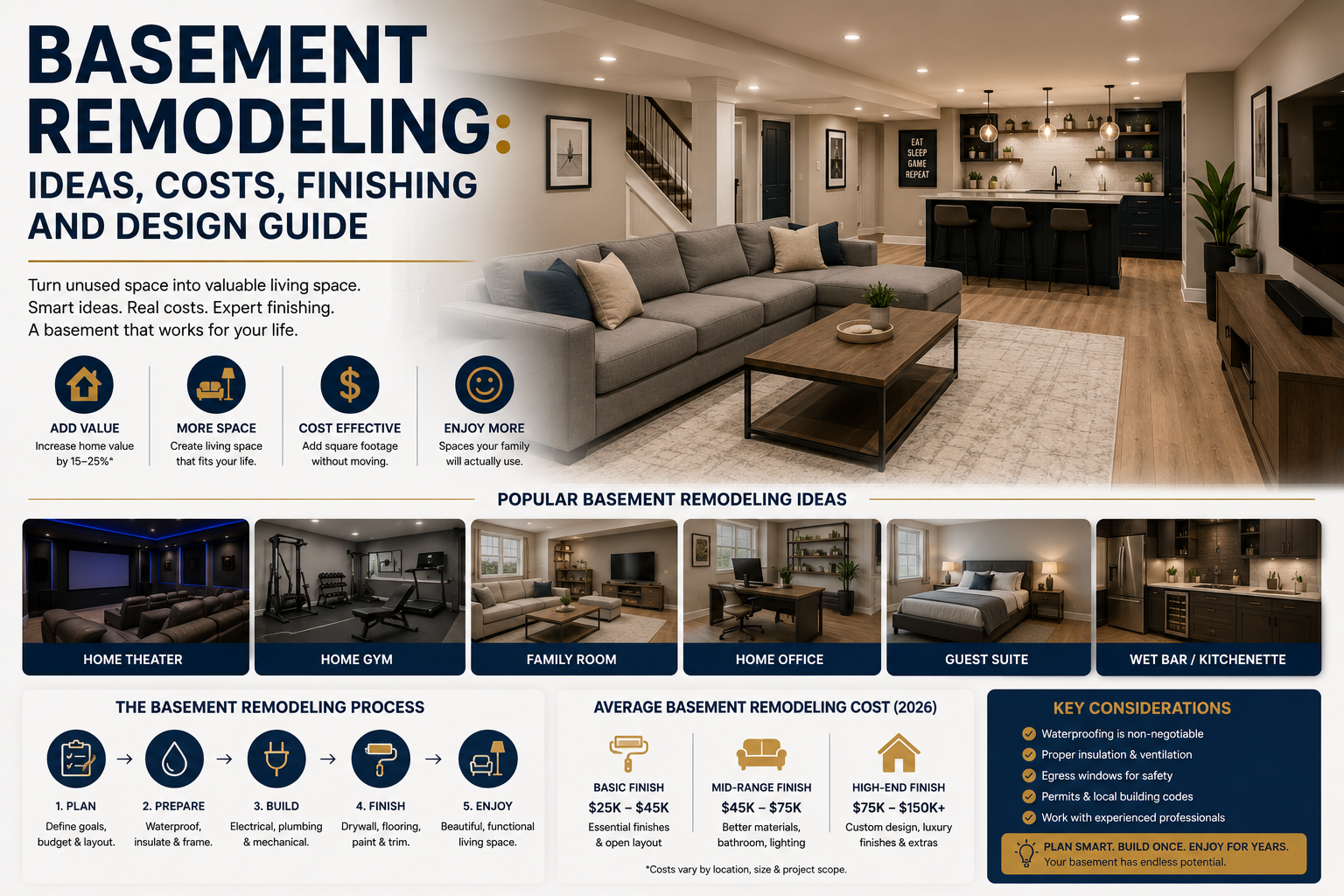
Introduction
Walk into most basements and the story is the same. Boxes everywhere. A broken elliptical. Shelves full of things nobody has touched in four years. It is not a living space. It is just a place where stuff ends up.
That is changing fast in 2026.
Basement remodeling has become one of the most searched home improvement projects in the country, and the reasons are straightforward. Housing prices never really came down the way buyers hoped. Moving to get more space costs more than most families want to spend. But the square footage under the house? Already paid for. Already sitting on a foundation. Already connected to the electrical panel and the HVAC system.
A properly finished basement adds 15 to 25 percent to home value in most markets. According to the NAR Remodeling Impact Report, basement finishing ranks among the top home improvement projects for both value recovered at resale and homeowner satisfaction after completion. It gives you a room that actually works for your life whether that is a home office, a rental unit, a gym, or a place where the kids can be loud without bothering everyone upstairs.
Basement remodeling rewards people who think carefully before they build. It punishes people who rush. The difference between a below-grade living space that lasts twenty years and one that needs to be gutted in four usually comes down to decisions made before construction ever starts.
This guide covers everything: basement remodeling ideas, real costs, waterproofing, step-by-step process, and how to avoid the mistakes that turn basement projects into expensive regrets. If you are ready to turn unused square footage into something that actually works, this is where to start.
What Is Basement Remodeling?
People throw around the words finishing, remodeling, and renovation like they mean the same thing. They do not, and the difference affects your budget before you spend a single dollar.
- Basement finishing means starting from zero. Bare concrete walls. Exposed joists above your head. A raw slab underfoot. Nothing livable about any of it. Finishing means framing walls, running electrical and plumbing, installing insulation and drywall, choosing flooring, adding a ceiling. If your basement currently looks like the inside of an unbuilt house, you need finishing work.
- Basement remodeling is different. The basement is already finished, but something about it is not working. The layout is wrong. The finishes are from 1997. The space was built for one purpose and you need it to serve another. Remodeling means tearing some of the existing work out and rebuilding it with a new direction in mind.
- Basement renovation splits the difference. It usually involves structural or mechanical fixes first, addressing water damage, replacing outdated wiring, fixing failing materials, before new finishes can go on top.
Know which one describes your project before you call anyone. It sets realistic expectations on cost and timeline from the start. Homeowners considering a larger scope often combine basement remodeling with home additions for maximum usable square footage and overall home value.
Basement Remodeling Trends 2026
The basement remodeling industry has shifted noticeably in 2026. Homeowners are not just finishing space for extra storage or a laundry room upgrade. They are designing intentional, multi-purpose living environments that serve real daily needs.
- Multifunctional spaces are the dominant trend. A single basement floor plan now commonly combines a home office zone, a workout area, and a lounge, each defined by lighting and layout rather than walls. Flexible design that shifts between uses throughout the day is what most families want from a custom basement design.
- Rental-ready basements are growing fast. Basement apartment conversion with a private entrance, a full bathroom, a small kitchen, and egress windows is becoming a standard planning request in markets where rental demand stays high.
- Wellness rooms are replacing traditional gyms. Dedicated yoga and meditation spaces, infrared sauna installations, and air purification systems are being incorporated into finished basement ideas more frequently than in any previous year.
- Smart lighting is now standard in higher-end basement remodeling projects. Automated LED systems that shift color temperature throughout the day, voice-controlled dimming, and scene presets for home theater or workout modes are all practical options in 2026 at accessible price points.
- Luxury entertainment zones remain strong. A basement theater room with acoustic treatment, a wet bar, and quality seating continues to be one of the most requested finished basement ideas among homeowners with larger renovation budgets.
- Sustainable materials are entering more basement projects. Recycled content flooring, low-VOC insulation products, and ENERGY STAR certified products improve efficiency and reduce utility costs over the life of the finished space.
Basement Remodeling Ideas
Basement Living Room and Family Room Design
A basement family room does not need to feel like a basement. The two things that make below-grade living space feel dark and closed-in are poor lighting and low ceilings. Fix those two problems and the rest is normal interior design.
Lean into a cozy lounge atmosphere. A deep sectional, warm lighting on dimmers, a large rug over hard flooring, and built-in shelving on one wall make a space people actually want to sit in. Light wall colors reflect available light. A wood panel or shiplap accent wall adds character without shrinking the room.
Plan all speaker wiring and media connections during the framing stage. Adding those things after drywall goes up costs more time and looks worse.
Basement Bedroom Ideas
A basement bedroom works well for guests, teenagers, or family members who need their own space. One thing is not negotiable: egress windows. According to US building code guidelines under the International Residential Code, a basement bedroom must have a window with a minimum opening of 5.7 square feet, a minimum width of 20 inches, and a minimum height of 24 inches. Egress windows require digging outside the foundation wall to create a window well, but they also bring in natural light every day. Skip egress and you have a code violation and a genuine safety hazard.
Basement Home Office Setup
Basements are naturally quieter than rooms on upper floors. With basic acoustic insulation in the walls, a basement home office is the quietest room in the house. For remote professionals on video calls all day, that matters.
Plan electrical carefully. You need more outlets than seem necessary, at least one dedicated ethernet port, and layered lighting that includes task lighting at the desk and bias lighting behind monitors.
Basement Gym Ideas 2026
Heavy equipment belongs on concrete. Basements stay cooler than upper floors. For basement gym ideas 2026, rubber flooring over the slab is the right call. It protects equipment, absorbs impact, and holds up for years. Ventilation is critical. Connect the space to your HVAC system or add a dedicated exhaust fan rated for the room size.
Basement Theater Room Design
A basement theater room rewards infrastructure planning done during framing. Projector mount blocking in the ceiling, in-ceiling speaker wire runs, screen wall framing, and power outlet placement at equipment locations. All of this costs almost nothing during framing and a significant amount after drywall is up. Acoustic panels on rear and side walls improve sound quality noticeably.
Luxury Basement Remodeling Ideas
A wet bar with a sink, undercounter refrigerator, solid cabinetry, and pendant lighting turns a basement into a gathering space. A wine cellar with a dedicated cooling unit, stone wall finishes, and wooden racking is the direction many homeowners take when budget allows for a true custom basement design.
Basement Finishing vs. Remodeling
- Finishing a raw basement means everything gets built from scratch. Basement framing, insulation, electrical, plumbing, drywall, flooring, ceiling. The scope is large but predictable because there is nothing to work around except the mechanical equipment that stays.
- Remodeling an existing finished basement costs more per square foot because the demo comes first. Removing old walls, flooring, and ceilings adds labor time and disposal costs before anything new goes in.
- On timeline, a clean finish of raw space typically takes four to eight weeks for an experienced crew. A full remodel runs eight to twelve weeks, sometimes longer if hidden problems turn up behind existing walls.
- Both types of projects require permits for electrical, plumbing, and structural work. Our home remodeling page covers the permit process in detail for homeowners in Northern Virginia. Skipping permits creates problems when you sell the house.
Basement Waterproofing and Moisture Control
In real renovation projects, moisture issues are the number one failure point that leads to gutting and redoing completed work. This is not a step to skip or postpone. Water finds basements through multiple paths. Groundwater pushes through foundation walls and slabs. Rain pooling near the foundation finds cracks over time. Warm humid air meets cool concrete and condensation forms inside wall cavities. Any one of these problems left unaddressed destroys a finished basement through mold, rot, and structural damage.
- Exterior waterproofing is the most thorough fix. Excavate around the foundation perimeter, apply a foundation waterproofing membrane to the outside wall face, and install drainage tile at the footing. Most disruptive and most expensive, but most effective long term.
- Interior waterproofing is what most residential basement renovation projects use. An interior drainage channel runs along the perimeter at the base of the foundation walls and feeds into a sump pit. Sump pump installation removes the collected water. A battery backup is not optional. The times the sump pump works hardest are the same times the power goes out.
- Basement humidity control with a properly sized dehumidifier handles ambient moisture year-round. Modern smart units drain continuously and adjust automatically based on actual readings.
- Basement vapor barrier and insulation work together at the foundation wall. Closed-cell spray foam applied directly to the inside face of foundation walls is the best basement insulation choice available in 2026. It insulates and creates a vapor barrier simultaneously. Rigid foam board is a solid lower-cost alternative when installed correctly. Contact our waterproofing team to schedule a moisture assessment before planning begins.
Basement Flooring and Ceiling Options 2026
- Flooring Hardwood and standard laminate do not belong in basements. Both absorb moisture and fail below grade over time.
- Luxury vinyl plank flooring is the most popular basement flooring choice in 2026. It handles moisture well, installs as a floating floor that can be lifted if the slab needs access, is comfortable underfoot, and the visual quality has improved to where most people cannot tell the difference from real wood at a glance. It costs less than hardwood and installs faster.
- Epoxy flooring suits gyms, workshops, and utility areas. Applied correctly over properly prepared concrete it is seamless, extremely durable, and easy to clean.
- Porcelain tile works well in bathrooms and wet bar areas.
- Carpet tiles are smarter than wall-to-wall broadloom in finished basement ideas because individual tiles can be replaced when one section gets wet or damaged.
Basement Ceiling Options 2026
- Drop ceilings with removable grid tiles are practical because tiles lift out for access to pipes and electrical above. The cost is ceiling height.
- Exposed ceiling solves the height problem. Paint all joists, pipes, and ductwork a consistent matte black or white and leave everything visible. It costs less, preserves every inch of height, and looks intentional when done well.
- The drywall ceiling gives the most polished look but sacrifices above-ceiling access. Acoustic drywall or resilient channel mounting reduces floor-to-floor noise noticeably in bedroom and office applications.
Basement Lighting and Ventilation
Lighting in a basement does more work than anywhere else in the house. There is little or no natural light to fill in the gaps. What you install is what you get.
- Layered lighting is the approach that works. Recessed downlights provide general coverage across the room. Sconces or pendants add visual interest at specific points. Under-cabinet lighting in a bar or kitchenette serves a task purpose. Floor lamps in seating areas bring light down to a comfortable level and warm the room significantly.
- Put ambient circuits on dimmers. The ability to shift from bright and functional during the day to relaxed in the evening changes how a below-grade living space feels entirely.
- ENERGY STAR certified products improve efficiency and reduce utility costs over the life of the finished space. LED fixtures run at a fraction of the operating cost of older incandescent or fluorescent options and last significantly longer. Warm white around 2700K suits living spaces and bedrooms. Neutral to cool white at 4000 to 5000K works better in offices and gyms.
- Ventilation matters most in gyms and any space where humidity builds. Most finished basements connect to the home's existing HVAC system. A dedicated exhaust fan in workout or utility spaces improves air quality and moisture control.
Basement Remodeling Cost in 2026
- A basic basement finish with standard materials and no bathroom runs $25,000 to $40,000 for 1,000 square feet in most US markets. A full bathroom addition adds $10,000 to $20,000 depending on plumbing complexity and fixture quality.
- A mid-range basement remodeling project with better finishes, a full bathroom, and some built-in cabinetry lands between $50,000 and $80,000 for the same footprint.
- High-end basement remodeling with premium finishes, a wet bar, home theater buildout, or wine cellar runs $100,000 to $150,000 and higher.
- Labor accounts for roughly 40 to 50 percent of the total cost to finish a basement. The items that push budgets up fastest are bathroom additions, foundation waterproofing systems beyond basic interior drainage, egress window installation, and structural changes for ceiling height.
- According to the NAR Remodeling Impact Report, basement conversions deliver strong cost recovery at resale alongside high homeowner satisfaction scores compared to other major home improvement projects.
Get at least three written quotes from licensed basement contractors who have physically walked the space. Estimates given over the phone based on square footage alone are not reliable enough to build a budget around. Request a free basement remodeling estimate from SB Builders.
Basement Remodeling Process Step by Step
- Step 1: Inspection and Planning
Look at the space honestly before designing anything. Check for moisture staining, foundation cracks, the condition of existing mechanical systems, and the location of equipment that needs to stay accessible. If there are signs of water intrusion, that gets resolved before planning moves forward. - Step 2: Design Layout
Finalize the floor plan with real ceiling heights, actual mechanical constraints, and egress window requirements already accounted for. A designer catches layout problems in this stage that would cost serious money to fix during construction. - Step 3: Waterproofing
Complete all waterproofing and moisture control before framing begins. Interior drainage, sump pump installation, basement vapor barrier, and foundation waterproofing system at walls. This work comes first and does not get postponed. - Step 4: Basement Framing and Insulation
Frame partition walls using pressure-treated lumber at the base plate wherever it contacts concrete. Install closed-cell spray foam at foundation walls and rim joists. Batt insulation in interior partition walls. Rim joist insulation stops the single largest air infiltration point in most basements. - Step 5: Electrical, Plumbing, and HVAC
Rough-in all mechanical systems while walls are open. Add capacity for future needs: ethernet ports, speaker wiring, additional circuits. This is the cheapest moment to do it. - Step 6: Rough-In Inspections
Permit inspections happen at this stage. Do not close up walls before inspectors sign off. - Step 7: Drywall, Flooring, and Ceiling
Close the walls, complete the ceiling, then install flooring. Paint before flooring wherever possible. - Step 8: Fixtures, Trim, and Final Inspection
Install plumbing and electrical fixtures, cabinetry, doors, and trim. Final inspection closes out the permits and certifies the finished space.
Common Basement Remodeling Mistakes
- Skipping waterproofing. Moisture issues are the number one failure point in basement renovation. An unresolved moisture problem under new finishes does not stay hidden. It gets worse until the whole space needs to be gutted.
- Ignoring ceiling height. Below seven feet most adults feel uncomfortable standing upright. If structural height is limited, exposed ceiling options recover the inches a drop grid would have consumed.
- Treating lighting as a budget cut. In a space with no natural light, artificial lighting does all the work. A poor lighting plan produces a room people avoid regardless of how good everything else looks.
- No egress windows in bedrooms. Code violation under IRC standards. Safety issue. Creates problems at every home inspection for as long as you own the property.
- Burying mechanical equipment. Most licensed contractors recommend a minimum 30-inch clearance around major mechanical equipment. Design around it properly.
- Hiring based on lowest price. The cheapest bid almost always reflects something: unlicensed work, skipped permits, inferior materials. The savings disappear fast when problems appear on a basement remodeling project of any size.
Basement Remodeling ROI and Value Increase
Finished basements sit near the top of all home improvement projects for return on investment. According to the NAR Remodeling Impact Report, basement conversions deliver strong value recovery alongside high homeowner satisfaction scores. A rental basement conversion that generates monthly income produces return in two ways at once: income during ownership and higher resale value when the property sells. In markets where rental vacancy stays low, a legal basement apartment can pay back the full renovation cost within a few years. Listings with finished basements in competitive markets attract more interest, support higher asking prices, and spend fewer days on market than comparable homes without finished below-grade square footage. Homeowners considering a larger renovation often combine basement remodeling with home additions for maximum basement value and overall property return.
Choosing Basement Remodeling Contractors Near Me
- Basement remodeling has specific requirements around moisture management, egress window installation, basement insulation, and below-grade code compliance that a general remodeler who occasionally does basement work does not handle as fluently as a specialist.
- Verify licensing and insurance before price discussions begin. A licensed basement contractor pulls permits. Permitted work gets inspected. Inspected work protects you during the project and protects your home's value at every future sale.
- Ask for a portfolio of completed basement remodeling projects specifically, not general remodeling work. Call the references. Ask how the contractor handled problems, because every project hits at least one unexpected issue.
- Get a detailed written contract. Scope of work, materials specified by name and model where relevant, payment schedule tied to construction milestones, timeline with key dates, and a clear change order process. Avoid any contractor who asks for a large upfront payment before work begins.
Contact SB Builders to speak with a licensed basement remodeling contractor serving Fairfax and Northern Virginia.
Frequently Asked Questions
A standard finish on raw space typically runs six to ten weeks for an active crew. A full basement remodel where existing finishes are removed first takes eight to fourteen weeks depending on scope and inspection scheduling.
Most homeowners spend $30,000 to $70,000 for a complete standard finish on 1,000 to 1,500 square feet. Basement remodeling cost per square foot runs $25 to $60 for standard work. Luxury basement remodeling with bars, theaters, or high-end materials runs $100,000 and above.
Yes. A finished basement adds 15 to 25 percent to home value in most markets and delivers 70 to 86 percent return on project cost at resale according to the NAR Remodeling Impact Report. It also reduces days on market in competitive listings.
The most cost-effective approach is an open-plan finish with standard luxury vinyl plank flooring, exposed ceiling treatment (painted joists), basic recessed lighting, and no added bathroom or kitchen. Keeping the layout simple and avoiding plumbing rough-in in new locations saves significant labor cost.
Luxury vinyl plank flooring is the best overall choice for most finished basement ideas in 2026. It handles moisture, installs as a floating floor, is comfortable underfoot, and costs less than hardwood. Epoxy flooring suits gyms and utility areas. Porcelain tile works best in bathrooms and wet bar areas.
In many municipalities yes. A basement apartment conversion typically requires minimum ceiling height of seven feet, egress windows in sleeping areas, separate plumbing and electrical service, adequate ventilation, and local zoning compliance. Requirements vary by location. Check with your local building department before planning begins.
For any work involving framing, electrical, plumbing, or HVAC: yes. Unpermitted basement renovation creates problems at resale, during insurance claims, and at any future renovation that exposes what was done without inspection.
For most homeowners with unused below-grade space, yes. Basement finishing cost per square foot is lower than any above-grade addition. Basement renovation ROI at resale is solid. The functional benefit to daily life starts the day the project finishes.
Conclusion
A basement is square footage you already own. What it does with its time is a choice you make, or do not make. Basement remodeling in 2026 makes financial and practical sense for homeowners who need more livable space, want rental income from a basement apartment conversion, or care about what the property is worth at resale. The math on converting unused below-grade space beats almost every alternative that does not involve buying a completely different house.
Basement remodeling projects that succeed share a few things in common. Serious planning before construction begins. Moisture control is treated as non-negotiable. Licensed basement contractors doing permitted work. Custom basement design that reflects how the space will actually be used day to day. Whatever the basement becomes, a home office, a basement gym, an in-law suite, a rental unit, or a luxury basement theater room, the starting point is always the same. Decide what you actually need the space to do. Then build that. The room is already there. Everything else is just work.
Start your basement remodeling project with SB Builders and get a free on-site estimate today.